![[object Object]](https://i0.wp.com/getmimo.wpcomstaging.com/wp-content/uploads/2025/02/The-11-Best-Python-Online-Courses-with-Certificates-2025.jpg?fit=1920%2C1080&ssl=1)
Our 12 Favorite Online Python Courses with Certificates (2026)
Python is a general-purpose programming language that remains one of the highest-paying in tech today—and one of the easiest to learn.
We reviewed and tested the top Python courses online to find the ones that genuinely teach practical, real-world programming and offer recognized certificates.
Here are the 12 best online Python courses to check out in 2026, whether you’re starting from scratch, upskilling for work, or building your own projects.
Table of Contents
1. Mimo’s Python Courses
2. Python for Everybody Specialization by University of Michigan (Coursera)
3. Python Institute’s PCEP Certification
4. Codecademy’s Learn Python 3 course
5. 100 Days of Code: The Complete Python Pro Bootcamp on Udemy
6. Google IT Automation with Python on Coursera
7. CS50’s Introduction to Programming with Python (Harvard)
8. MIT’s Introduction to Computer Science and Programming in Python
9. Python for Data Science and Machine Learning Bootcamp (Udemy)
10. edX Python for Data Science
11. IBM Python for Data Science, AI & Development
12. Introduction to LLMs in Python by DataCamp
Why we selected these Python courses
Choose the best Python course for your needs
1. Mimo’s Python Courses
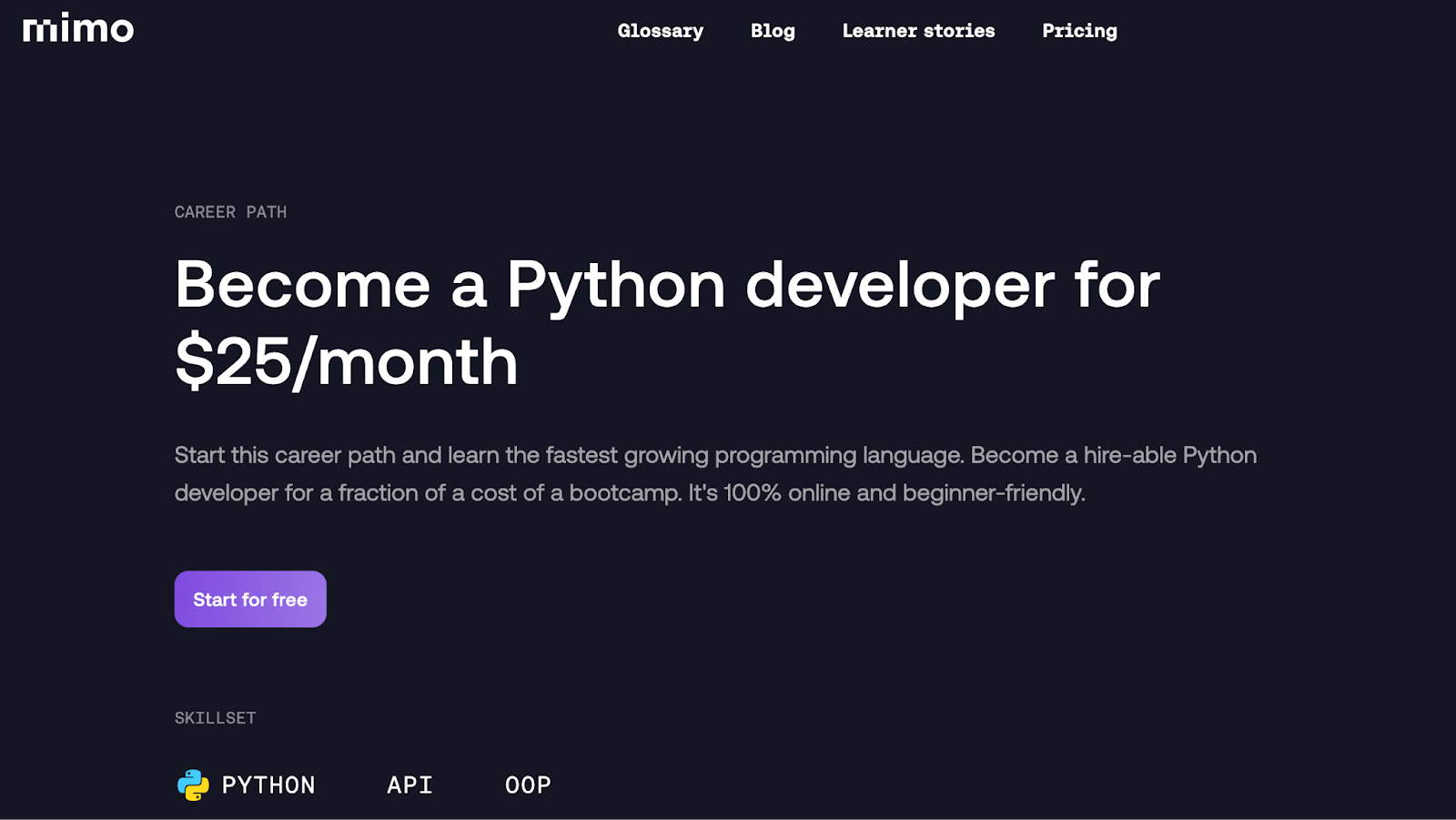
Key details:
- Key focus: Python fundamentals in the basic course, AI development and job preparation in the career path
- Level: Complete beginner to job-ready
- Format: Interactive learning with practical tasks and projects
- Time to complete: Self-paced – 14 modules for the basic course, 8 major sections with 23 coding challenges for the career path
- Certification: Yes (both paths)
- Price: Offers a limited free plan. The paid plan that also includes other Mimo’s courses comes at USD 39.99/month or USD 24.99/month with an annual subscription.
Mimo is the best Python course option if you want to learn Python by doing—not watching—thanks to its fully interactive, hands-on curriculum.
It offers two different learning paths:
- Fundamental Python course for beginners: Breaks down core programming concepts into bite-sized, interactive lessons. Covers essential data types, basic algorithms, and fundamental programming concepts.
- Comprehensive Python AI Developer career path: A structured, end-to-end track that builds your Python foundation and expands into AI-focused topics (machine learning, data handling, and practical project work).
No matter which option you choose, you get access to bite-sized interactive lessons, practical assignments, hands-on exercises, and an integrated code editor with AI assistance.
The career path also guides you through building eight portfolio projects along the way, including games, API integrations, and data analysis tools.

All of this makes Mimo a great platform for beginners. You can learn at your own pace, acquire practical skills quickly, and earn a recognized certification.
Pros and Cons
Pros:
- Two clear paths depending on your goal—quick fundamentals or full career prep
- Interactive lessons with built-in code editor and AI assistance
- Real portfolio projects in the career path that you can show employers
- Modern platform that works on both desktop and mobile
- An important focus on practical job skills and AI development
Cons:
- Full access requires a paid subscription
- Somewhat basic for experienced Python coders
- Doesn’t offer a lot of direct instructor support
2. Python for Everybody Specialization by University of Michigan (Coursera)
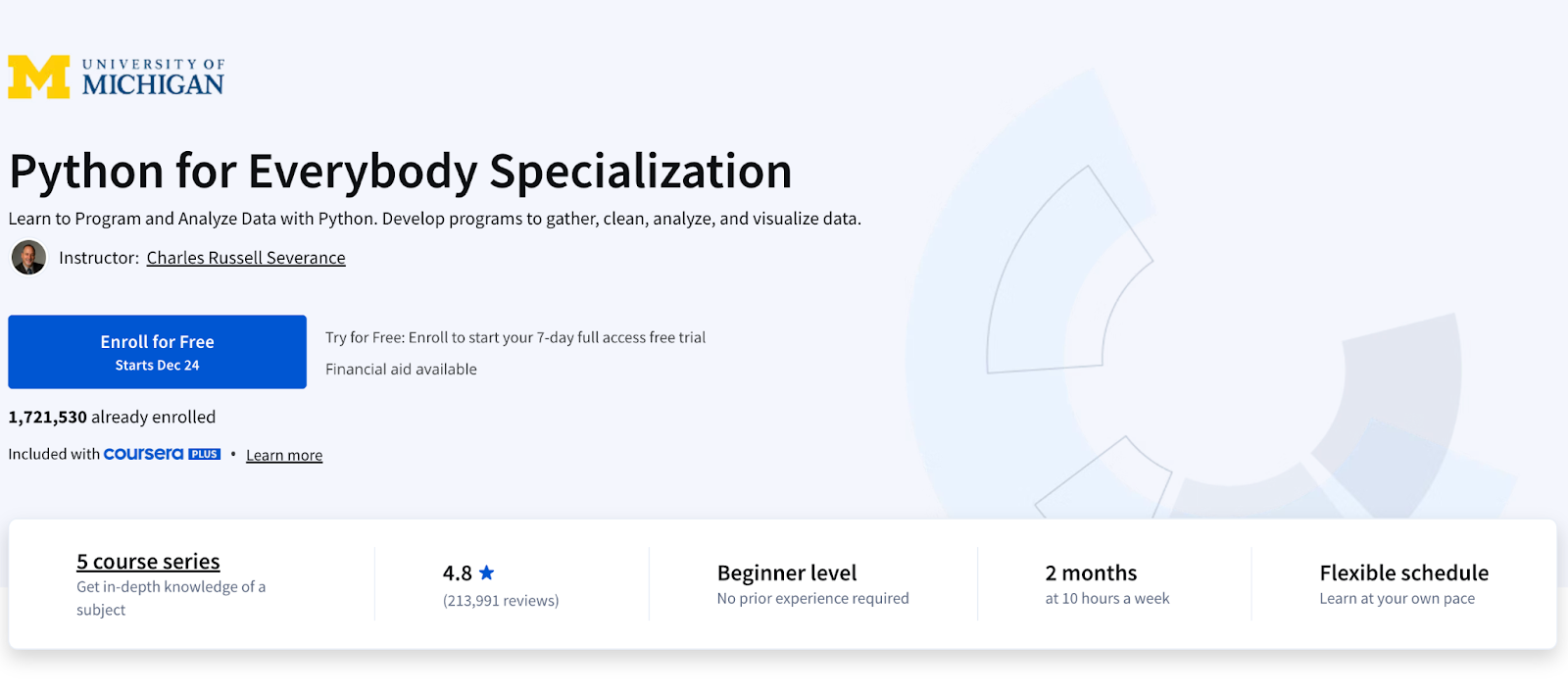
Key details:
- Key focus: Python programming with emphasis on data analysis and manipulation
- Level: Beginner (no prior experience required)
- Format: Video lectures, assignments, discussion forums, and hands-on projects
- Time to complete: 2 months at 10 hours per week
- Certification: Yes
- Price: a 7-day free tial, then USD 45/month for full access and certification
The University of Michigan’s Python specialization is a five-course series for absolute beginners.
It starts with the basics and builds up to more complex topics like data analysis and visualization.
The curriculum is pretty straightforward.
You’ll start by learning fundamental programming concepts, then move on to working with data structures, web data, and databases.
Everything wraps up with a capstone project where you’ll build your own data analysis tool.
You’ll also see how to use Python to solve real-life problems—like pulling data from websites and working with APIs.
Pros and Cons
Pros:
- Well-structured progression from basics to advanced topics
- Taught by an experienced professor
- Mix of video lectures and coding practice
- Active discussion forums for getting help
- Great for learning data-focused Python skills
Cons:
- Offers a slightly more academic approach, which might be slow and not practical enough for some students
- Mostly focused on data vs general Python programming
- Limited interactivity
3. Python Institute’s PCEP Certification
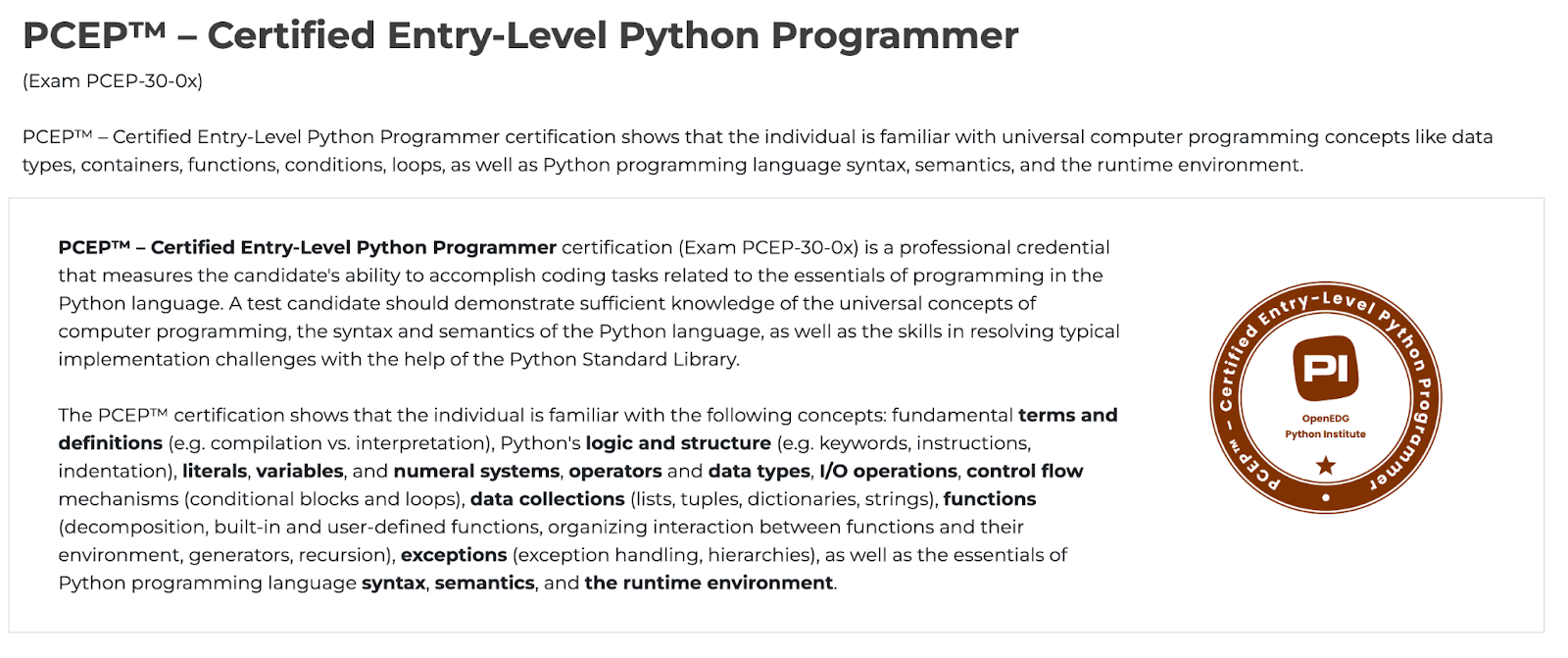
- Key focus: Core Python programming fundamentals and computer science concepts
- Level: Complete beginner
- Format: Free online course with written tutorials and coding exercises
- Time to complete: 6-7 weeks (suggested 6-7 hours/week)
- Certification: Yes (exam fee required)
- Price: The course is free; the certification exam costs USD 59
If you want a recognized credential to show employers, the PCEP (Python Certified Entry-Level Programmer) certification and its Python Essentials 1 course are solid starting points.
It’s an entry-level certification that teaches the basics of Python programming and computer science concepts, with the course helping you prep for the exam.
This online Python course is ideal for complete beginners, guiding you through everything from basic syntax to functions and loops.
The best part? PCEP certification is widely recognized by employers and could be a good first step in your programming career.
Pros and cons
Pros:
- The course is completely free to take
- Provides a recognized professional certification
- Strong foundation for pursuing more advanced Python certifications
- Self-paced format fits any schedule
- Focused on practical programming skills you can apply right away
Cons:
- Requires a separate payment for the certification exam
- No videos or interactive lessons—the course is entirely text-based
- Limited instructor interaction and support
- The certification exam comes with strict technical requirements
4. Codecademy’s Learn Python 3 course
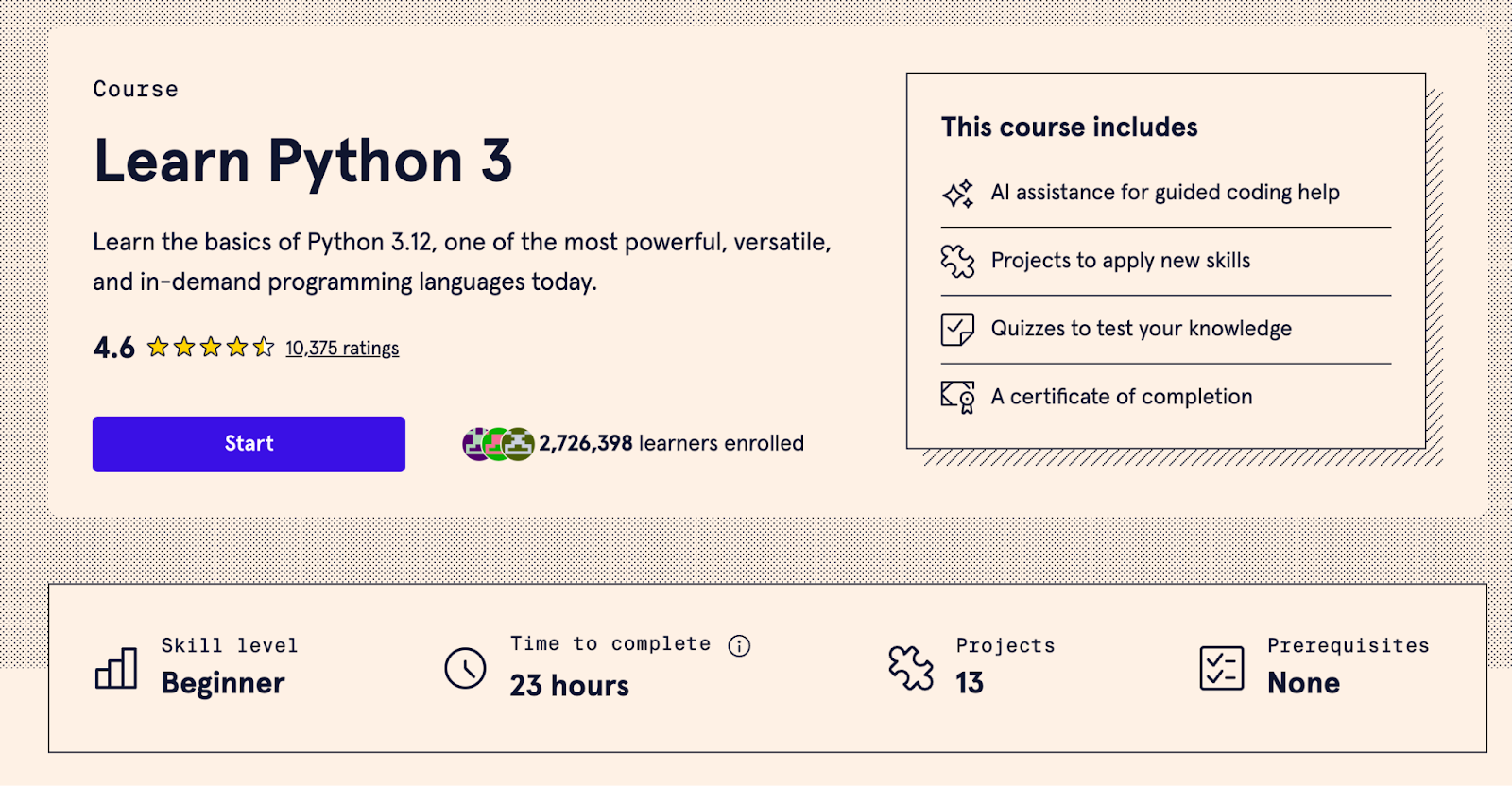
Key details:
- Key focus: Core Python programming fundamentals with practical applications
- Level: Complete beginner
- Format: Interactive coding exercises, projects, and quizzes
- Time to complete: 23 hours
- Certification: Yes (with paid plans)
- Price: Free basic access, USD 14.99/month (Plus) or USD 19.99/month (Pro) when billed annually
Codecademy is an interactive platform that offers a 23-hour Python course for beginners.
It’s divided into 14 sessions, during which you’ll work through concepts like loops, functions, and data structures.
You’ll also start basic coding from day one and complete various projects and quizzes to test your knowledge.
Each lesson builds on the previous one, and you receive instant feedback as you code.
They also include an AI assistant that can help explain concepts or debug your code when you’re stuck.
Pros and Cons
Pros:
- Interactive learning with immediate code feedback
- Good balance of theory and practical projects
- AI assistance is available for debugging
- Engaging, project-based curriculum
- You can start learning for free
Cons:
- The certificate requires a paid plan
- The topics are limited to the very basics
- Projects are fairly guided – offering limited creative freedom
5. 100 Days of Code: The Complete Python Pro Bootcamp on Udemy
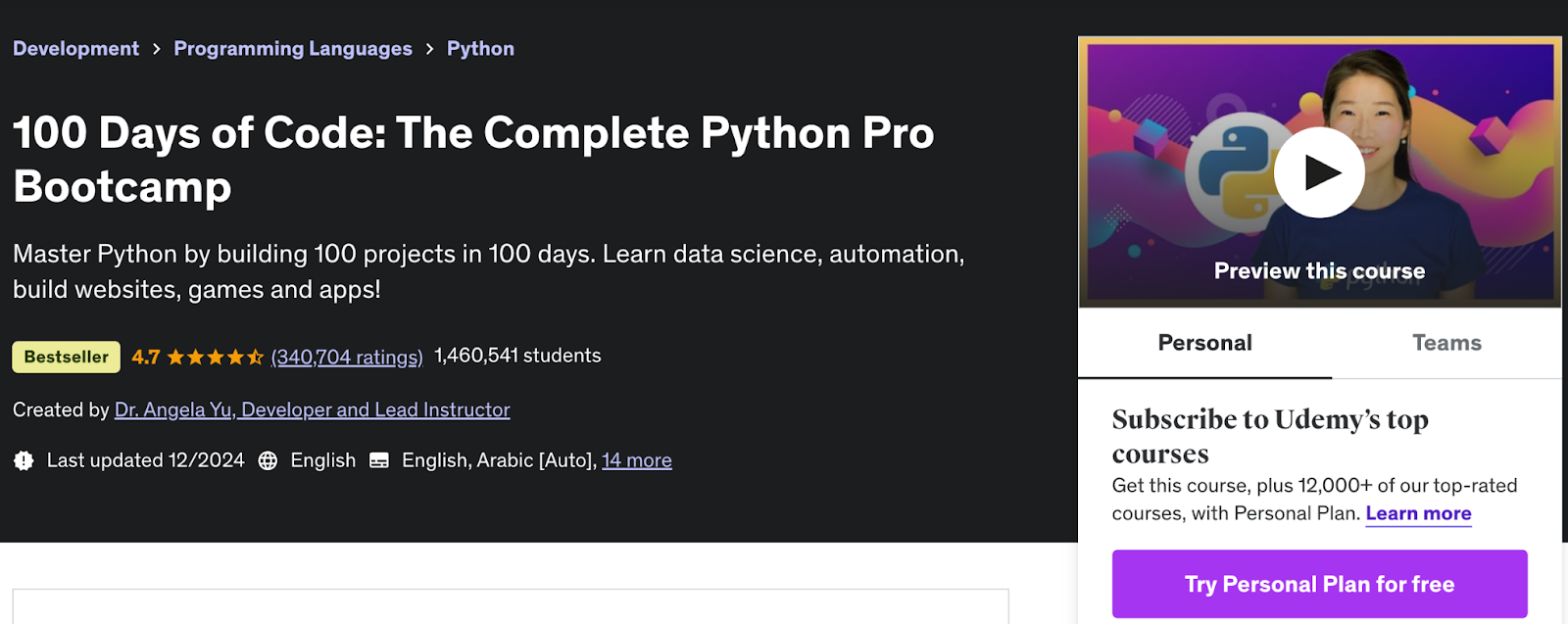
Key details:
- Key focus: Python programming with focus on practical projects
- Level: Beginner to advanced
- Format: Video lectures, coding exercises, and daily projects
- Time to complete: 100 days at 1 hour per day (56+ hours of video content)
- Certification: Yes
- Price: USD 124.99 (often on sale)
The Python Pro Bootcamp on Udemy is a comprehensive course that takes you from a complete beginner to a professional through 100 days of coding.
The unique thing about this course is its project-based approach—you’ll build something new every day, from simple games to web applications and automation tools.
The course is taught by Dr. Angela Yu who breaks down complex concepts with clear explanations and animated visualizations.
It covers various topics, starting with Python basics and advancing to professional tools like Selenium, Flask, and Pandas.
Pros and Cons
Pros:
- Project-based learning with 100 practical projects
- Comprehensive coverage from basics to advanced topics
- Clear explanations with animations and visualizations
- Includes web development, data science, and automation
- Active student community for support
Cons:
- Time commitment is significant
- Later, more advanced sections have less video guidance
- Some projects might feel rushed in the one hour timeframe and lack explanations
6. Codecademy’s Learn Data Analysis with Pandas
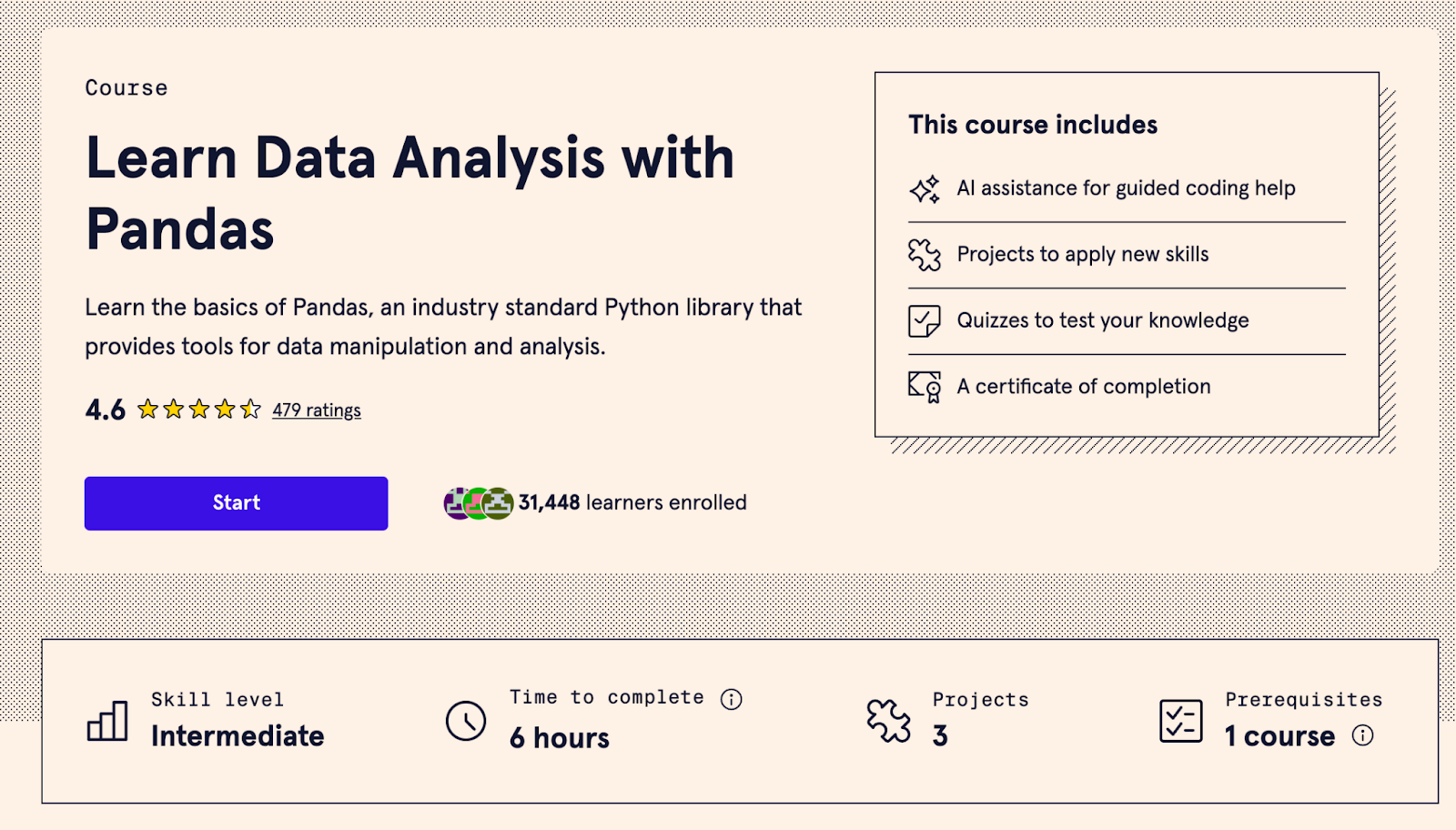
Key details:
- Key focus: Data analysis using the Pandas library
- Level: Intermediate (requires Learn Python 3 course as a prerequisite)
- Format: Interactive lessons, coding exercises, and projects
- Time to complete: 6 hours
- Certification: Yes (with paid plans)
- Price: Free basic access, paid plans for certificate, and additional features
Codeacademy also offers a course for those looking to learn data analysis. It focuses on Pandas—Python’s powerful library for working with data.
It’s a shorter, more focused course that teaches you how to manipulate and analyze data in table format, similar to what you might do in Excel but with Python’s added capabilities.
The course is structured around three main topics: basic Pandas operations, working with aggregate functions, and handling multiple data tables.
You’ll work on practical projects like analyzing store inventory and A/B test data, giving you hands-on experience with real-world data analysis scenarios.
Pros and Cons
Pros:
- Focused specifically on data analysis skills
- Interactive coding environment
- Real-world project examples
- AI assistance for debugging
- Quick to complete
Cons:
- Requires prior Python knowledge
- The certificate requires a paid subscription
- More limited in scope than other comprehensive Python courses
7. Udemy’s Python PCAP Course
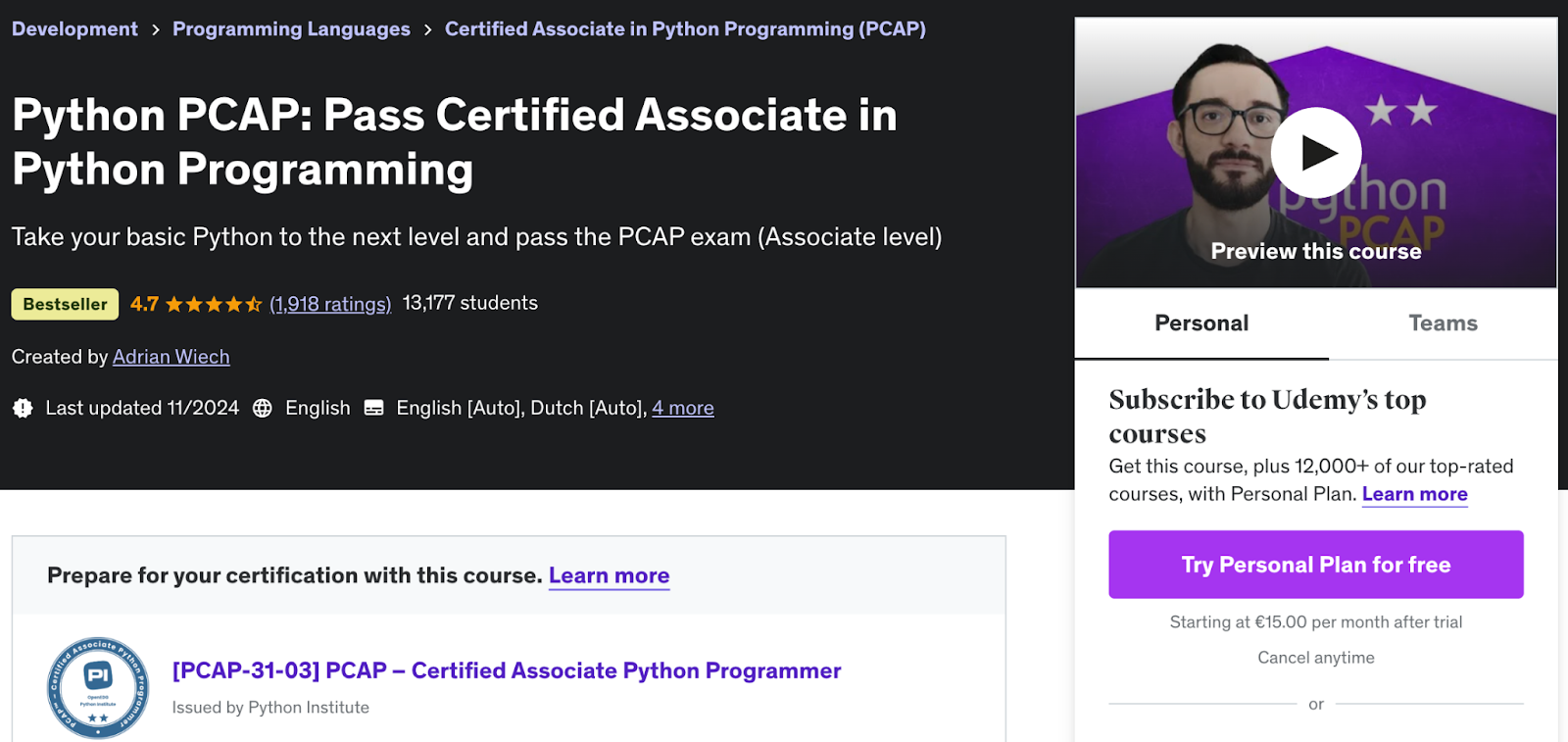
Key details:
- Key focus: Intermediate Python concepts and PCAP certification preparation
- Level: Intermediate (requires basic Python knowledge)
- Format: Video lectures, coding exercises, and practice tests
- Time to complete: 5.5 hours
- Certification: Yes
- Price: USD 84.99 (often on sale)
If you’ve already got basic Python skills and want to level up, Udemy’s course helps you prepare for the PCAP (Python Certified Associate Programmer) certification.
It’s taught by Adrian Wiech, a senior software developer who focuses on practical programming skills rather than just theory.
The course is structured around the PCAP exam’s five main topics, with each section ending in a practice quiz.
You’ll learn intermediate Python concepts like object-oriented programming, working with modules, and exception handling.
You’ll also build three practical programs to apply what you’re learning.
At the end, you’ll get a mock PCAP test with the same format and time limit as the real thing, helping you prep for the real exam.
Pros and Cons
Pros:
- Direct preparation for PCAP certification
- Practical projects based on real-world scenarios
- Includes a mock exam with the actual exam format
- Concise, focused lectures
- Lifetime access to course materials
Cons:
- Requires basic Python knowledge to start
- Higher price point than some alternatives
- Limited coverage of topics outside the PCAP syllabus
8. DataCamp’s Data Analyst in Python Track
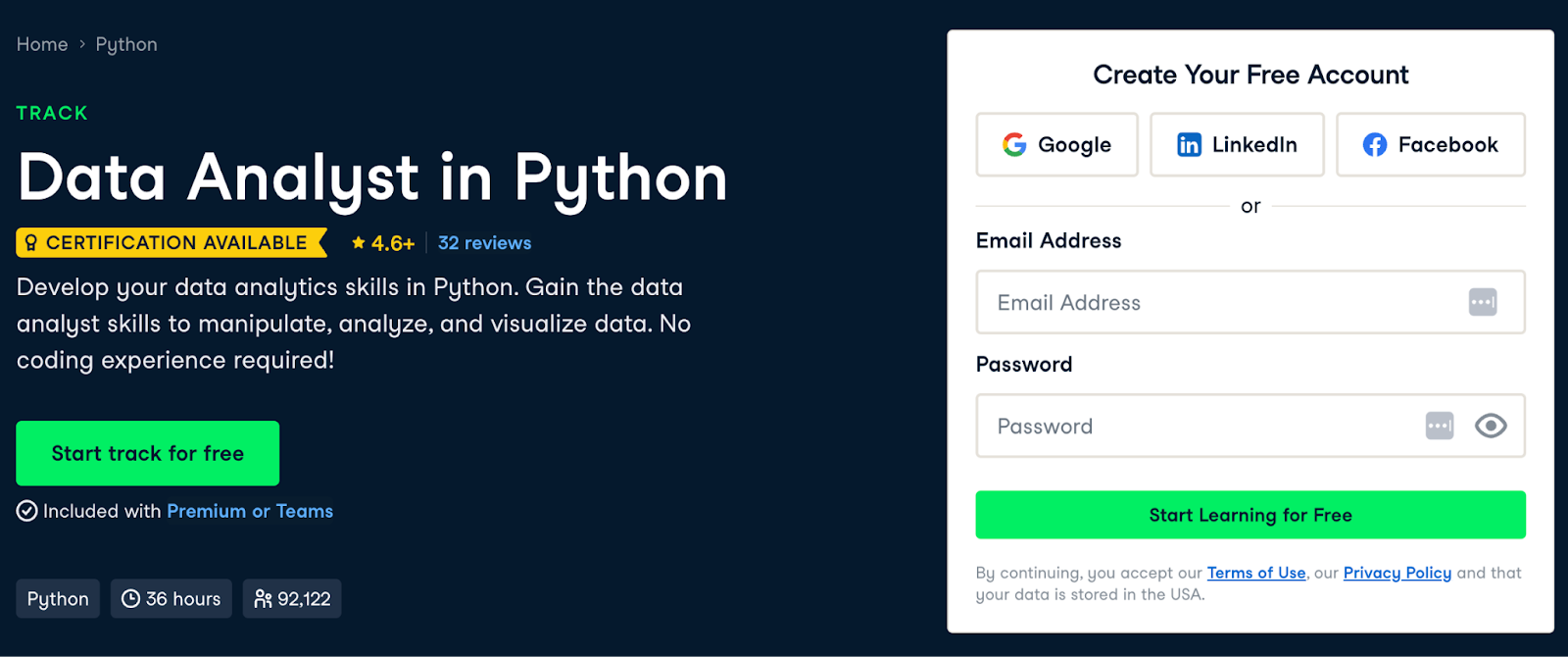
Key details:
- Key focus: Python programming for data analysis
- Level: Beginner (no coding experience required)
- Format: Interactive courses and hands-on projects
- Time to complete: 36 hours
- Certification: Yes
- Price: Free plan with limited access, USD 27/month for full access
DataCamp’s career track combines Python programming with practical data analysis skills.
The course doesn’t require prior coding experience but covers advanced topics like data manipulation and hypothesis testing.
The curriculum is split between learning Python fundamentals and applying them to real data analysis tasks.
The track takes you through importing, cleaning, manipulating, and visualizing data using popular libraries like Pandas, NumPy, and Seaborn.
You’ll also work on practical projects like analyzing Netflix movies and exploring NYC public school test scores.
9. Python for Data Science and Machine Learning Bootcamp
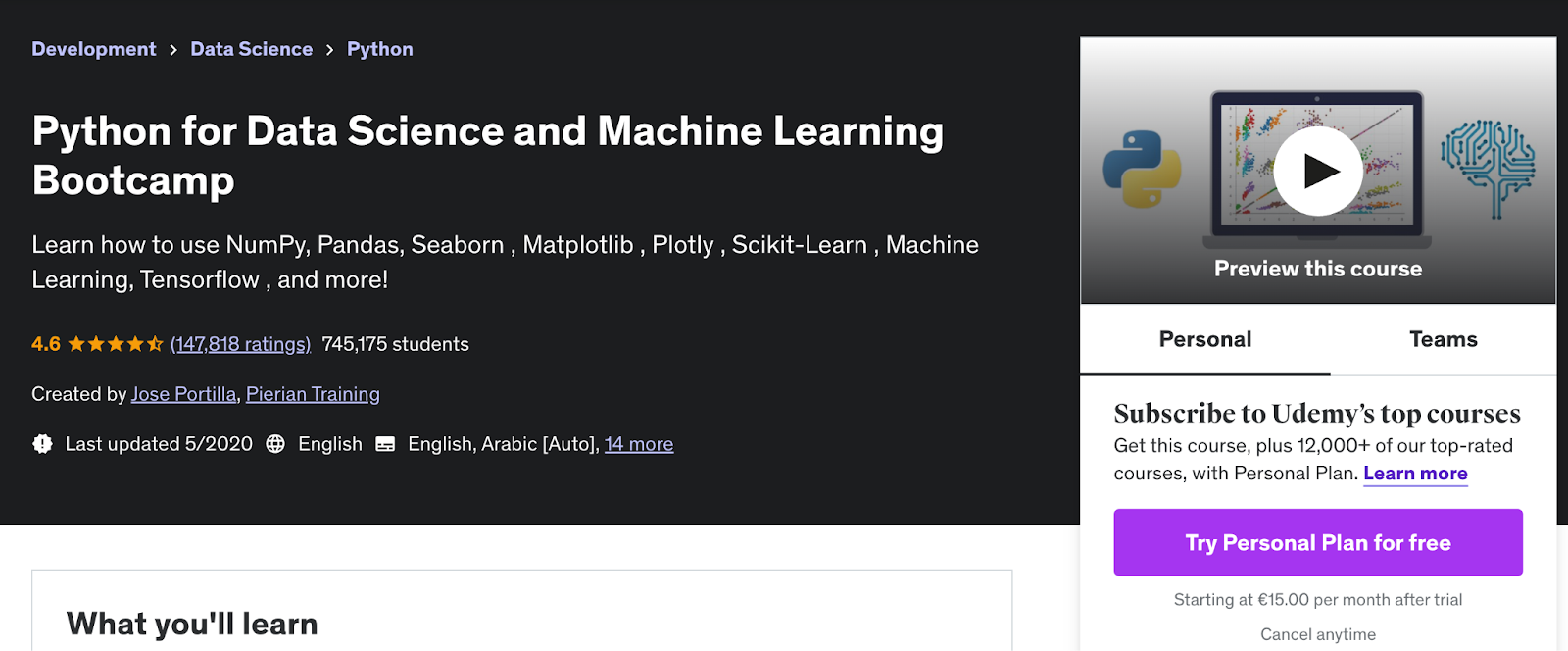
This comprehensive bootcamp teaches you how to use Python’s most important data science libraries.
The course covers various topics, from basic data manipulation with Pandas to advanced machine learning with Scikit-Learn.
The curriculum combines theory with hands-on practice, teaching you both the tools and their practical applications.
You’ll learn essential libraries like NumPy for numerical analysis, Matplotlib and Seaborn for visualization, and Plotly for interactive charts.
The course also includes machine learning basics using Scikit-Learn.
Key details:
- Key focus: Python data science libraries and machine learning fundamentals
- Level: All levels (some programming experience would be helpful)
- Format: Video lectures and downloadable resources
- Time to complete: 25 hours
- Certification: Yes
- Price: EUR 124.99 (often on sale)
Pros and Cons
Pros:
- Comprehensive coverage of major data science libraries
- Clear explanations of complex concepts
- Includes machine learning fundamentals
- Lifetime access to materials
Cons:
- It hasn’t been updated for a few years
- Some libraries may be outdated
- Limited coverage of advanced ML topics
10. Google’s IT Automation with Python Professional Certificate
Key details:
- Key focus: Python for IT automation and system administration
- Level: Beginner (no prior experience needed)
- Format: Video lectures, hands-on projects, and real-world assignments
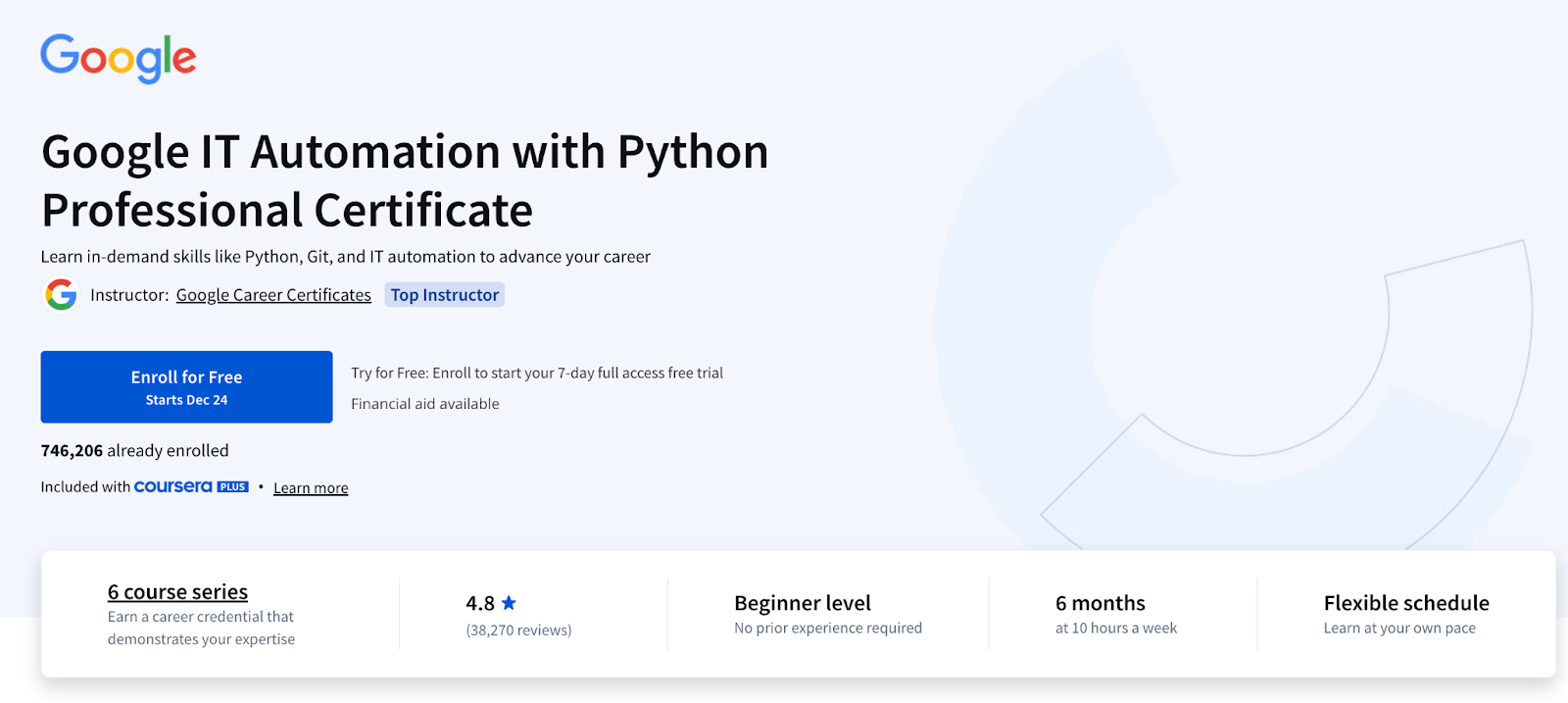
- Time to complete: 6 months at 10 hours/week
- Certification: Yes (Google Certificate)
- Price: 7-day free trial, USD 45/month after that
This certification program from Google teaches Python specifically for IT automation and system administration.
The six-course series covers basic Python programming and teaches you how to use it for real-world IT tasks like managing cloud resources and automating system administration.
The program’s key feature is its practical focus on using Python in IT roles. You’ll learn about data types, basic algorithms, and how to work with SQL databases in professional environments.
Each course builds toward automating real workplace tasks, with the final part focusing entirely on practical automation projects.
Pros and Cons
Pros:
- Direct path to IT automation skills
- Industry-recognized Google certificate
- Practical, job-focused projects
- Career resources and support
- Access to Google’s employer consortium
Cons:
- Requires significant time commitment
- Limited coverage of Python beyond IT uses
11. DataCamp’s Intermediate Python
Key details:
- Key focus: Data science tools and Python programming fundamentals
- Level: Beginner (requires basic Python knowledge)
- Format: Video lectures, interactive exercises, and case study
- Time to complete: 4 hours
- Certification: Yes
- Price: Free basic content, full access with Premium subscription
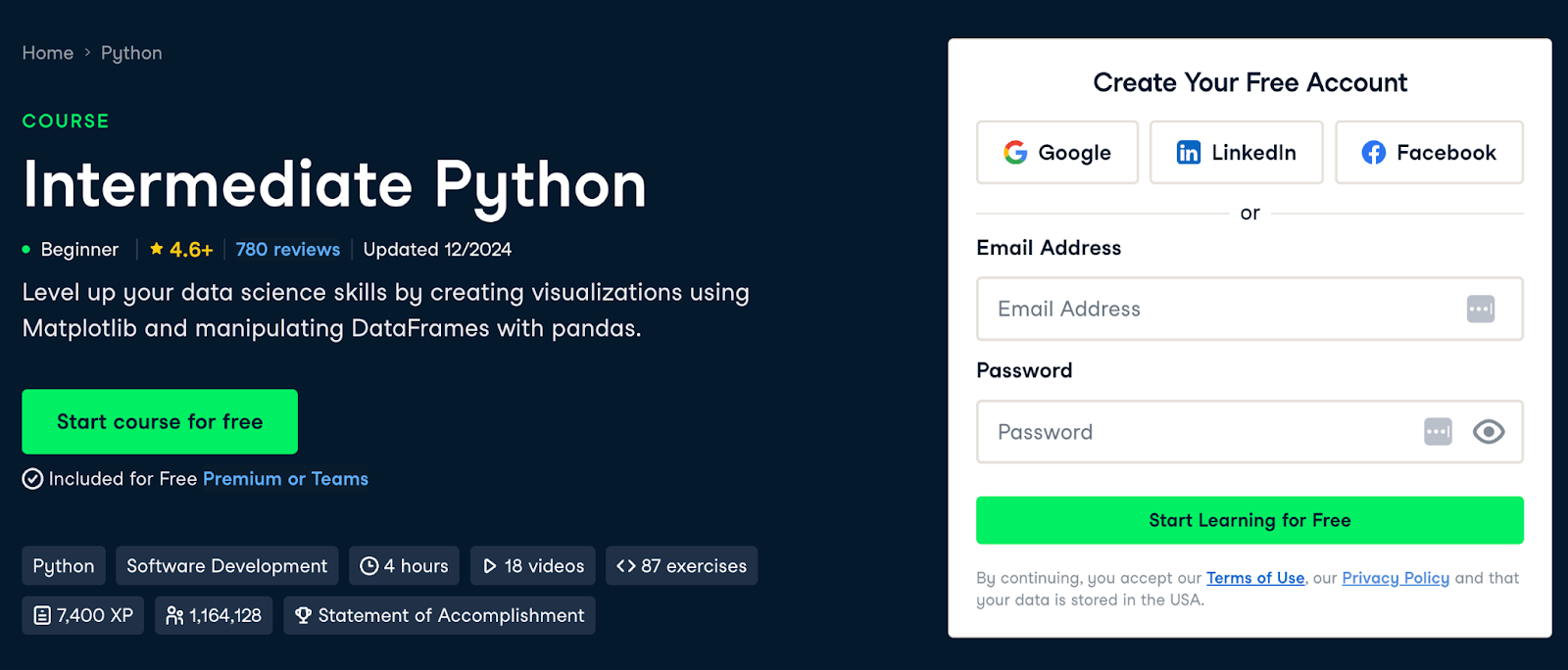
DataCamp’s Intermediate Python is a four-hour course focusing on Python tools needed for data science.
The curriculum covers visualization with Matplotlib, data manipulation using Pandas, and key Python concepts like loops and Boolean logic.
The course includes 87 hands-on exercises and concludes with a practical case study in hacker statistics.
Content is updated regularly, with the latest update in December 2024.
Pros and Cons
Pros:
- Short, focused lessons
- Hands-on practice with 87 exercises
- Recently updated content
- Includes real-world case study
- Interactive learning platform
Cons:
- Requires prior Python knowledge
- Limited to data science applications
12. Introduction to LLMs in Python by DataCamp

- Key focus: Building, fine-tuning, and evaluating LLMs using Python and transformer architectures
- Level: Intermediate
- Format: Video lessons, interactive coding exercises, and hands-on projects
- Time to complete: 3 hours
- Certification: Statement of accomplishment
- Price: Included in Premium or Teams plans
The Introduction to LLMs in Python course helps you move beyond using AI tools and start understanding how modern LLMs are built.
It breaks down how transformer architectures work, why they’ve become standard for NLP, and what actually happens inside an LLM when it generates text.
You’ll learn how to load and work with pre-trained models from Hugging Face, fine-tune them on new datasets, and evaluate their outputs with metrics specific to language models.
The course also touches on real-world considerations like model bias, ethical risks, and the limits of current LLMs.
It’s a practical, concept-first course that helps you understand why LLMs behave the way they do and how to adapt them for your own projects.
Pros and cons
Pros:
- Makes core LLM and transformer concepts easy to understand
- Includes hands-on practice with Hugging Face and real model fine-tuning
- Helpful introduction to evaluation metrics used in NLP and LLM workflows
- Covers practical issues like bias and real-world deployment challenges
Cons:
- Requires a paid DataCamp subscription
- Not suitable for total beginners—you need some Python + deep learning basics
- Limited instructor interaction
Why we selected these Python courses
We evaluated dozens of Python courses available online and selected these based on key criteria:
- Reviews and ratings: Strong student feedback and high completion rates (4.5+ stars on average)
- Curriculum structure: Well-organized content progressing from basics to advanced topics
- Practical application: Focus on real-world projects and industry-relevant skills
- Learning format: Mix of theory and hands-on practice through exercises and projects
- Industry recognition: Credentials valued by employers
- Teaching quality: Clear explanations and updated content
- Price-to-value ratio: Good balance of cost versus content
- Focus areas: Coverage of different Python applications (web development, data science, automation)
- Support resources: Additional materials like documentation, forums, and career guidance
Are Paid Python Certificates Worth It?
Paid Python certificates can be worth it if they give you stronger credibility, better structure, or clear career value, but paying more does not automatically make a course better.
For beginners, free certificates are often enough to start learning and show progress. Paid verified certificates make more sense when you want university-backed recognition, stronger LinkedIn visibility, or a credential that supports job applications in competitive roles.
The most important factor is still the quality of learning. A free course with real projects is often more valuable than an expensive certificate without practical experience.
Choose paid certificates for credibility, but choose courses for actual skill-building.
Do Python Certificates Help You Get Your First Developer Job?
Yes—Python certificates can help you get your first developer job, but they work best as proof of consistent learning, not as a replacement for real projects.
Employers usually care more about what you can build than the certificate itself. A certificate shows commitment and helps strengthen your resume or LinkedIn profile, but projects on GitHub and practical problem-solving carry more weight during interviews.
Platforms like Mimo help by combining certification with hands-on coding and portfolio-ready projects, which makes the learning more useful for job applications.
The strongest combination is a certificate that proves progress and projects that prove real skills.
Choose the best Python course for your needs
Finding the right online Python course depends on your goals and learning style.
Our list includes options for complete beginners, career changers, and those looking to develop specific skills like data science or IT automation.
Here are some standout choices:
- Mimo’s Python AI Developer Career Path: For those who want to build a career with a comprehensive learning path from basics to AI development
- Google IT Automation Certificate: For those seeking IT training with strong employer recognition
- DataCamp’s Data Analyst Track: For aspiring data analysts who want to learn Python and data science together
- Python Institute’s PCEP: For developers wanting an industry-recognized certification to validate their skills
- 100 Days of Code Bootcamp: For hands-on learners who want to build real projects using Django, data visualization, and other practical applications while learning
Tip: If you’re looking for additional practice, explore these free Python learning resources and try these beginner-friendly Python projects to build your skills.