
How Long Does It Take to Learn SQL? (And Find a Job)
A timeline by goal, a first SQL query to try, and tips for learning faster.
Most beginners can write useful basic SQL queries after a few weeks of regular daily practice. Mimo’s SQL course page estimates that most beginners learn basic SQL in 2 to 3 weeks of consistent daily practice. Joining tables, grouping the results, and writing subqueries take longer, depending on how often you practice and what you use SQL for.
Treat these times as a rough planning guide, not a measured average. No source gives a reliable time for the later stages, so the table shows what you can do at each stage instead.
| Goal | What you can do | Rough time with daily practice |
|---|---|---|
| Basics | Write SELECT with WHERE and ORDER BY, and simple COUNT or SUM | About 2–3 weeks (Mimo’s estimate) |
| Everyday analysis | Join two tables and use GROUP BY | Longer than the basics |
| Advanced | Use window functions and indexes, and read a query plan | Longer, with real projects |
| Mastery | Keep up with tools and dialects | Ongoing |
Table of Contents
How Long Does It Take to Learn SQL?
Try It: Your First SQL Query
Should You Learn SQL?
Top SQL Skills You Can Master
How Long Does It Take for Beginners to Learn SQL?
How Long Does It Take to Learn Advanced SQL?
Is SQL Easy to Learn?
How to Learn SQL: Tips for Accelerated Learning
Frequently Asked Questions
Conclusion
How Long Does It Take to Learn SQL?
SQL (Structured Query Language) is the language for working with data in relational databases. You use it to look up data, summarize it, and add or change records.
Think of learning SQL in stages, defined by what you can do rather than a fixed number of weeks.
Basic SQL skills
You can get data out of a single table. You write SELECT statements, filter rows with WHERE clauses, sort results, and do simple calculations, such as counting rows or adding up a column.
Checkpoint: You can write a SELECT with WHERE and ORDER BY, and use simple COUNT or SUM. In Mimo’s course, the SQL Basics, Filters, and Aggregate Functions steps cover this.
Intermediate proficiency
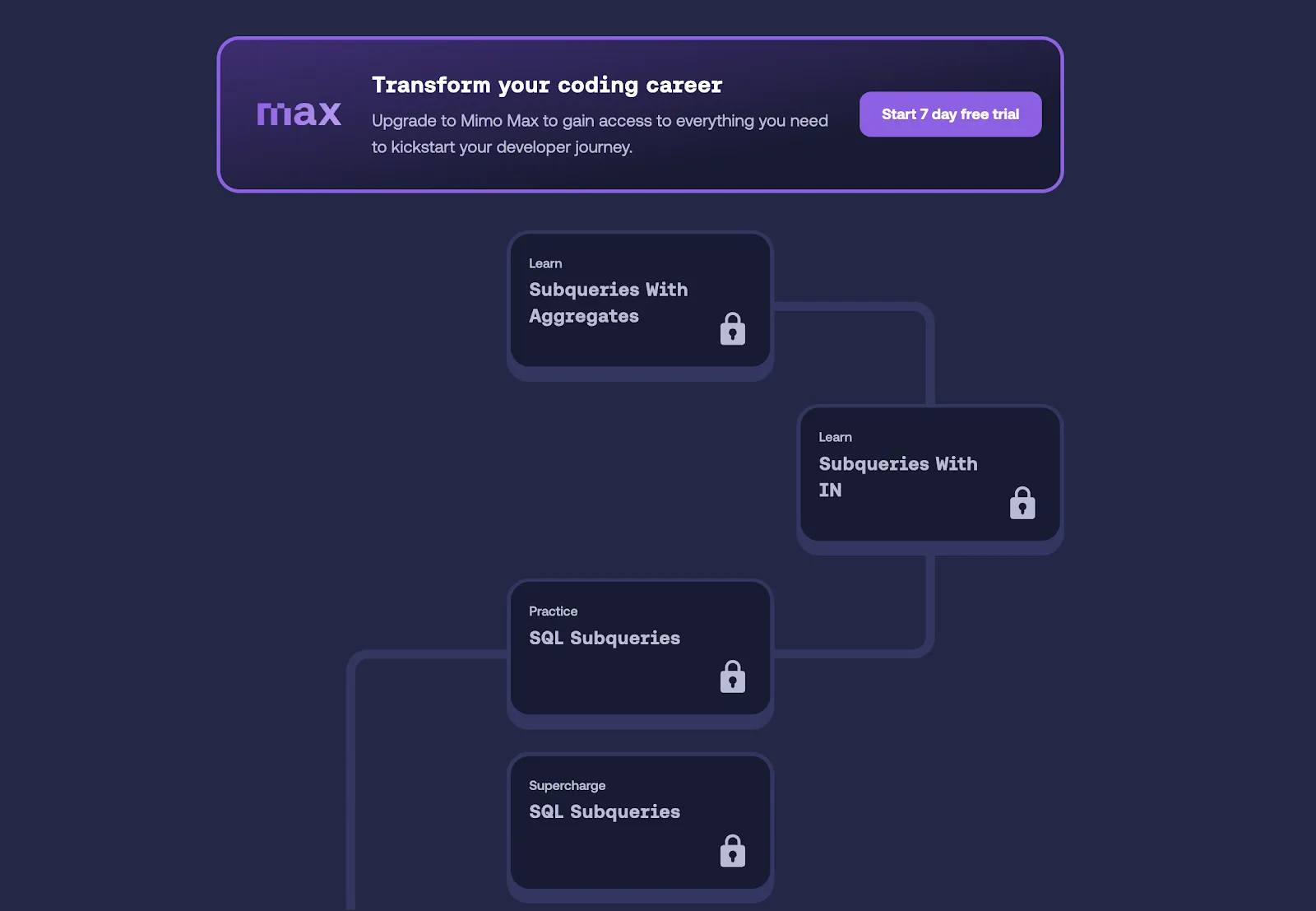
You can answer questions that need more than one table or step. You combine tables with joins, such as an INNER JOIN that keeps only matching rows. You group results with GROUP BY, often across joined tables, and nest one query inside another with subqueries.
This is the level many people need to use SQL for data analysis at work.
Checkpoint: You can join two tables and use GROUP BY to answer a question. In Mimo’s course, this is where the Joins and Subqueries steps come in.
Advanced proficiency
You can write complex queries and make them fast. Typical topics are window functions, indexes, and performance tuning. You also learn how database systems like MySQL, PostgreSQL, SQL Server, and SQLite differ.
Checkpoint: You can use window functions, add an index, and read a query plan to see how the database runs a query.
Most people reach this level by using SQL on real data over time, not by studying for a set period.
Mastery
There’s no finish line. SQL is a standard (ANSI/ISO) language, but each database adds its own features, and tools keep changing. Experienced users keep learning as their work requires it.
What affects how long it takes
- Prior experience: If you know another language from back-end or front-end development, or work a lot in spreadsheets, SQL will feel familiar sooner.
- Your goal: Pulling a weekly report needs less SQL than building or tuning a database.
- Practice frequency: Short daily sessions usually beat a long session once a week.
- Learning style: A structured path, such as one of these SQL courses, helps you avoid gaps. Practicing on real datasets helps the skills stick.
Try It: Your First SQL Query
This short example creates a small table of orders, adds three rows, and adds up the order totals for each customer. Paste it into any SQLite tool, or see how to run an SQL query for other options.
CREATE TABLE orders (
  id INTEGER,
  customer TEXT,
  total REAL
);
INSERT INTO orders VALUES
  (1, 'Ana', 40),
  (2, 'Ben', 25),
  (3, 'Ana', 35);
SELECT customer, SUM(total)
FROM orders
GROUP BY customer
ORDER BY SUM(total) DESC;
Expected result (your tool may lay the result out differently):
customer | SUM(total)
Ana      | 75.0
Ben      | 25.0
GROUP BY customer puts Ana’s two orders into one group and Ben’s order into another. The SUM function adds up the totals in each group, and ORDER BY ... DESC puts the biggest spender first. SQLite shows 75.0 and 25.0 because total is a REAL column; other databases may format them differently. To go further, read how to use GROUP BY in SQL.
Should You Learn SQL?
If you work with data, or want to, SQL is a good investment. In Stack Overflow’s 2026 Developer Survey, SQL (58.4%) came right after JavaScript (62.0%) among the languages respondents said they did extensive development work in over the past year.
SQL is also common in data and database jobs. The US Bureau of Labor Statistics (BLS) doesn’t count “SQL jobs,” but it does track occupations that commonly work with databases:
- Data scientists: 2025 median annual pay of $120,230, with 35% projected growth from 2025 to 2035, much faster than average (BLS, data scientists).
- Database administrators and architects: 2025 median annual pay of $126,760 (database administrators and architects combined), with 4% projected growth from 2025 to 2035, about as fast as average (BLS, database administrators and architects).
Both typically require a bachelor’s degree. These figures describe the occupations, not SQL, which is one skill among several in these roles.
Beyond these roles, SQL is useful in data analysis, business intelligence, and back-end development, and in finance, healthcare, e-commerce, or marketing jobs that involve data.
Top SQL Skills You Can Master
Which skills you need depends on your job. A typical learning order:
- Querying: SELECT, WHERE, and ORDER BY to get and sort data
- Aggregation: COUNT, SUM, AVG, MIN, and MAX with GROUP BY to summarize data
- Joins: combining data from several tables
- Subqueries and CTEs: queries inside queries, and named steps that make long queries easier to read
- Changing data (DML): adding rows with INSERT, and changing or removing them with UPDATE and DELETE
- Defining structures (DDL): creating, changing, and removing tables
- Window functions: rankings and running totals without collapsing rows
- Performance: indexes and query tuning
- Dialects: the syntax differences between MySQL, PostgreSQL, SQL Server, and SQLite
For basic analysis, querying, aggregation, and simple joins may be enough. If you build or maintain database applications, you’ll need the later skills too.
How Long Does It Take for Beginners to Learn SQL?
For beginners, the basics come fairly quickly, and you don’t need prior coding experience to start.
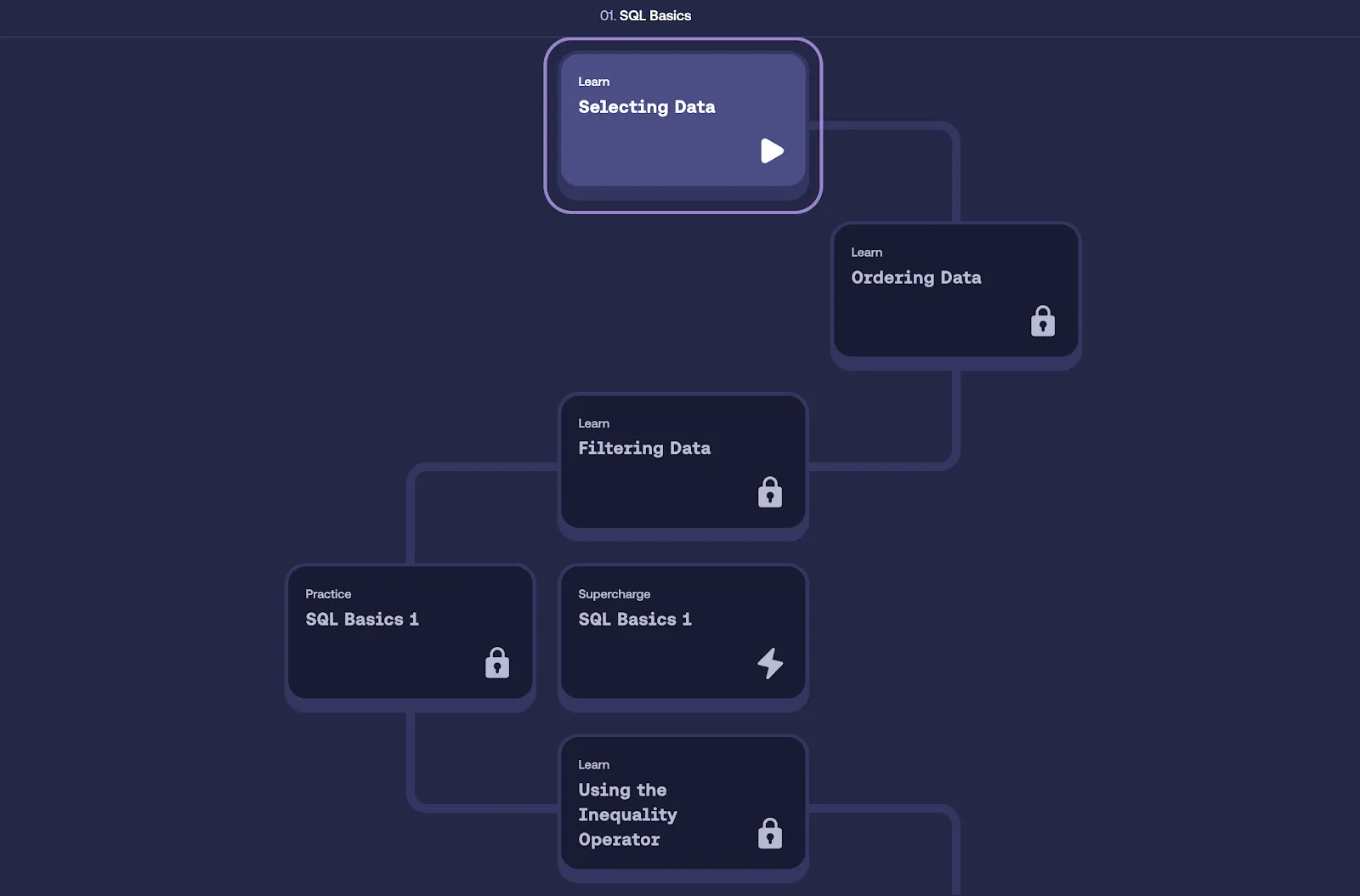
The Mimo SQL course moves through six steps: SQL Basics, Table Management, Filters, Aggregate Functions, Joins, and Subqueries, with interactive exercises and projects along the way.
How Long Does It Take to Learn Advanced SQL?
There’s no fixed timeline. Advanced SQL, like window functions, indexes, and performance tuning, mostly comes from using SQL on real data. Someone who writes queries every day at work will get there much sooner than someone who practices once a week.
To speed it up:
- Practice with larger, messier datasets, where slow queries become visible.
- Learn how your database runs a query, and try indexes to see what changes.
- Rewrite your own older queries to make them shorter or faster.
Is SQL Easy to Learn?
For most people, SQL is one of the easier languages to start with. Its syntax reads almost like English, and you can get useful results with only a few keywords.
The harder parts come later. Complex joins, subqueries, and performance tuning take logical thinking and practice.
How to learn SQL? Tips for accelerated learning
A structured approach and regular practice matter more than any single resource.
1. Start by mastering the basics
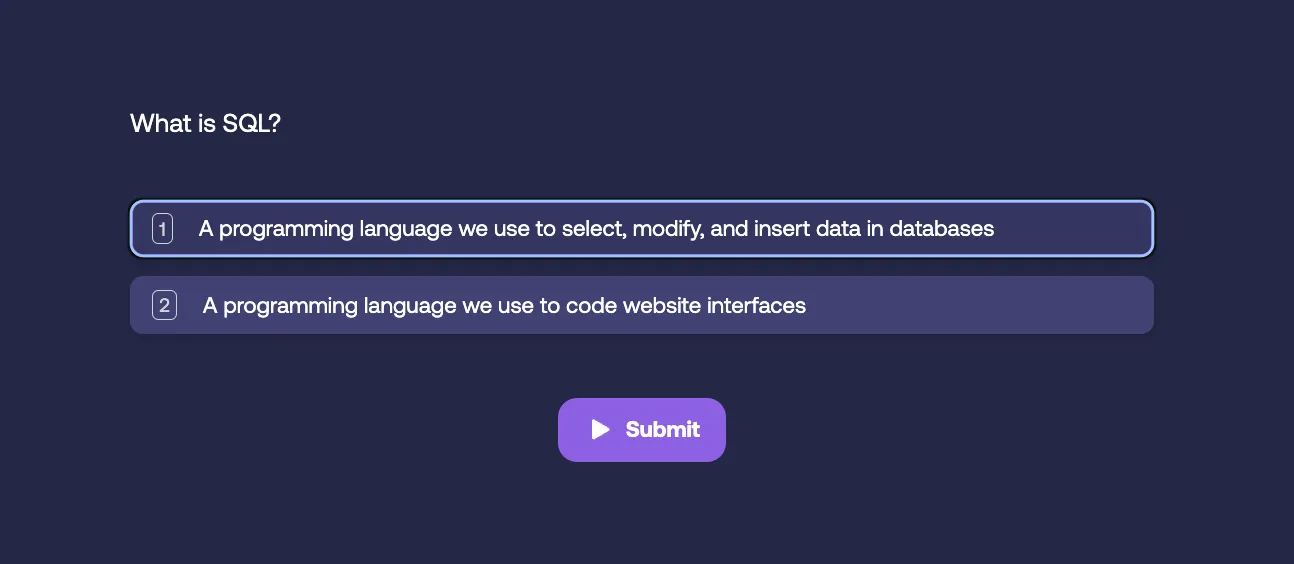
Learn to select and sort data, and filter it with WHERE, first. Mimo’s SQL Basics step covers retrieving, filtering, and organizing data with interactive questions:
Then add the statements that change data: INSERT, UPDATE, and DELETE. In Mimo’s course, the next step, Table Management, covers creating, updating, and deleting database tables.
Pro tip: Set up a small practice database with a free tool like MySQL Workbench or PostgreSQL and run basic commands on sample data.
2. Practice regularly
Set aside time each day to write queries and solve problems. Some places to practice:
- HackerRank’s SQL challenges
- DoltHub’s public databases
- Various SQL games
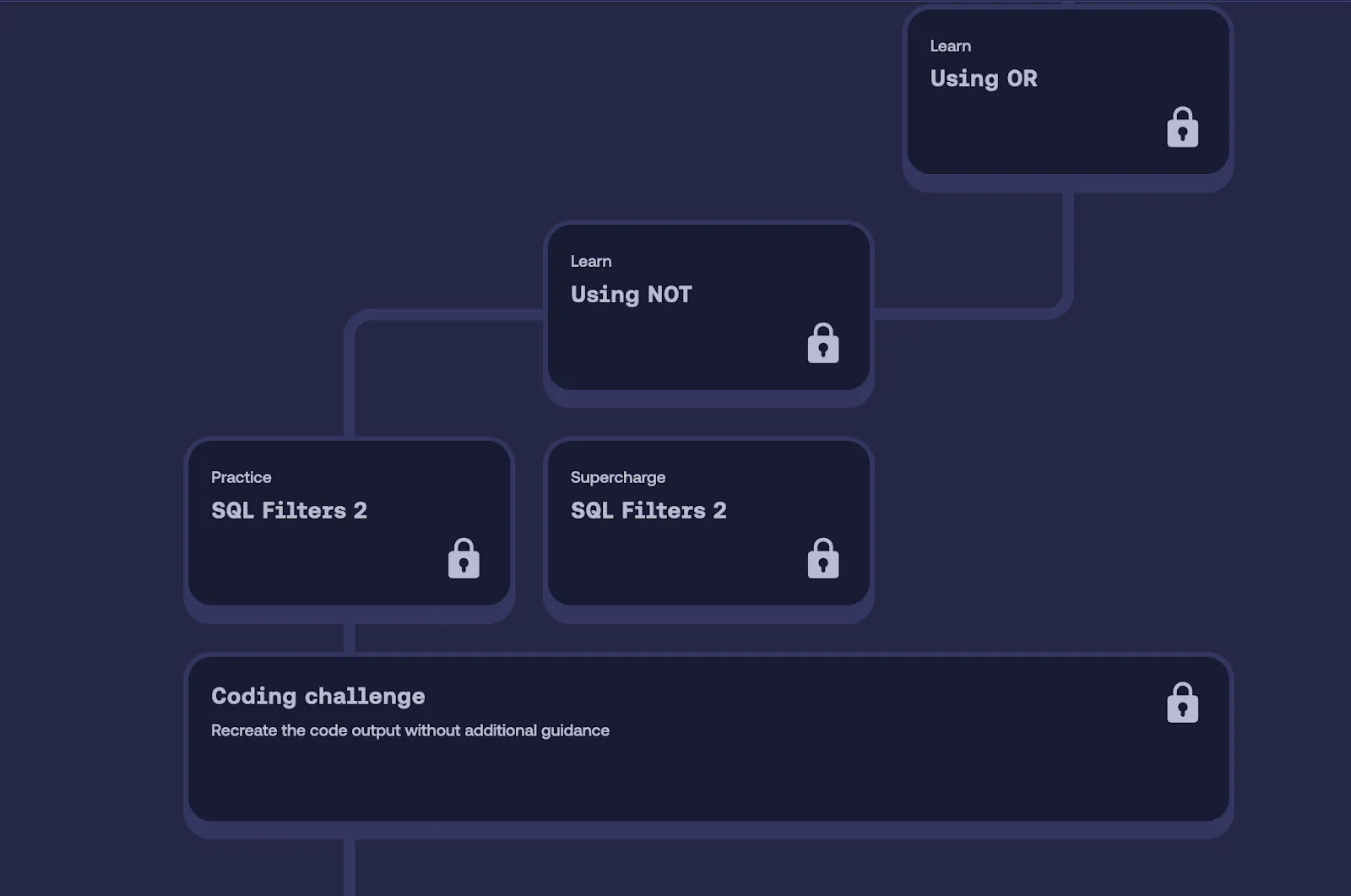
- Coding challenges in Mimo’s SQL course
Pro tip: Solve at least one SQL problem a day, and keep an SQL cheat sheet open for syntax you forget.
3. Work with real data
SQL gets easier once you use it on real questions. Try data from your job, public datasets, or your own projects. Kaggle and data.gov offer free datasets on topics like healthcare and finance.
Pro tip: When you see a report, such as a sales summary, try to write the queries that would produce it. Mimo’s SQL course also includes practical projects.
4. Engage with the SQL community
Forums are good places to ask questions and see how others solve problems. Try Reddit’s r/SQL and Stack Overflow.
Pro tip: Attend local meetups or online webinars about SQL and databases. Networking can help you learn new things and find job opportunities.
5. Build a portfolio and look for relevant jobs or projects
Put projects that solve real problems with SQL on GitHub. For each one, explain the question, your approach, and the queries you wrote.
If you’re job hunting, look at roles like data analyst, business analyst, or database administrator. Highlight your SQL projects on your resume, and expect technical questions in interviews.
Frequently Asked Questions
Is 1 month enough to learn basic SQL?
Often, yes. Mimo’s SQL course page estimates that most beginners learn basic SQL in 2 to 3 weeks of consistent daily practice, so a month of regular practice leaves time to review. In that time, you can learn to select, filter, and sort data and do simple counts, and start on grouping and joins.
Getting comfortable with joins, grouping, and subqueries in real work takes longer. A good checkpoint is when you can join two tables and use GROUP BY to answer a question. This is a rough planning guide, not a guarantee.
Is SQL enough to get a job?
Sometimes, but usually not on its own. SQL is a core skill in roles like data analyst, business analyst, and database administrator. Look at the job descriptions for the roles you want; many entry-level data roles list skills such as spreadsheets, a data visualization tool or Python next to SQL.
Projects that show you can answer real questions with SQL help you stand out. No course can guarantee a job.
Is SQL still in demand?
SQL is still widely used. In Stack Overflow’s 2026 Developer Survey, 58.4% of respondents said they did extensive development work in SQL over the past year. The US Bureau of Labor Statistics projects 35% employment growth for data scientists and 4% for database administrators and architects from 2025 to 2035. These are figures for the occupations, not a count of SQL jobs.
AI tools can suggest queries, but you still need to read SQL to check that a query answers the right question.
Conclusion
Plan on a few weeks of daily practice for the basics. Joins, grouping, and subqueries take longer, depending on how often you practice and what you use SQL for, and advanced skills grow with real use. Practice often and work with real data.